
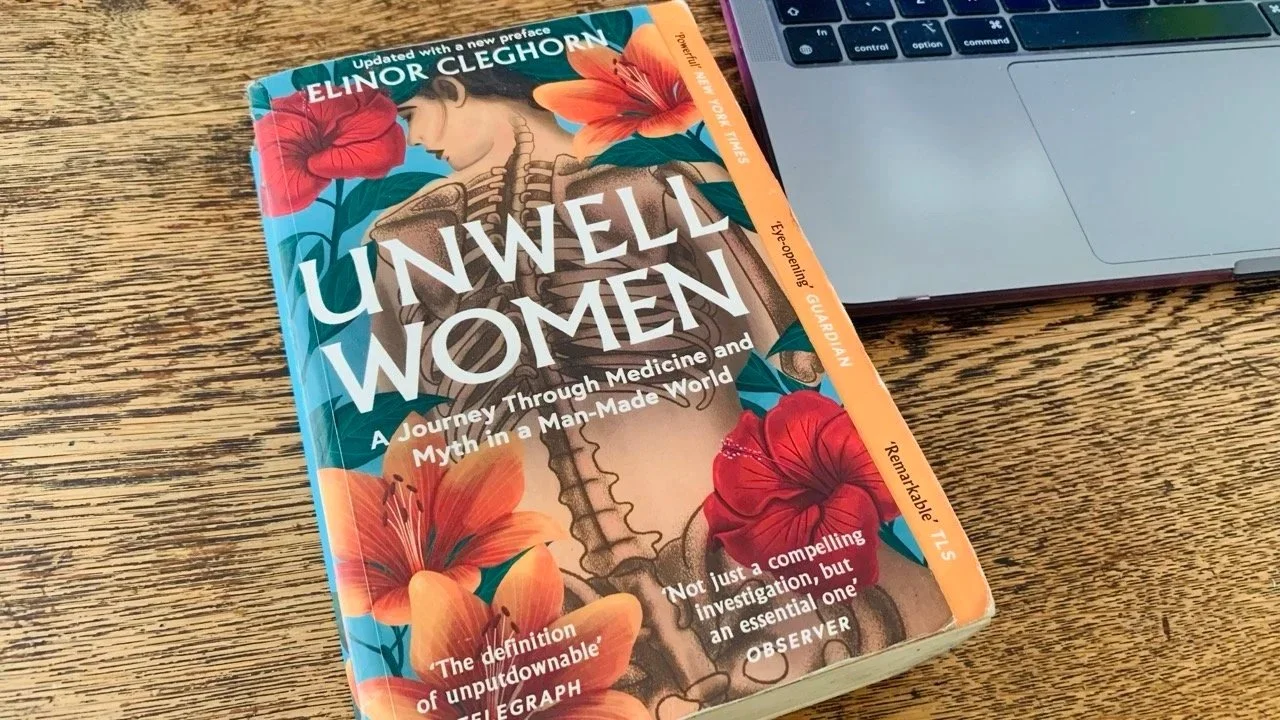
Unwell Women: A Journey Through Medicine and Myth in a Man-Made World
By Elinor Cleghorn
If you have ever left a medical appointment feeling dismissed, or wondered why it took so long for someone to take what you were experiencing seriously — this book sheds light on the origins of women’s health and medical approaches. Unwell Women by Elinor Cleghorn traces the history of how medicine has viewed women’s bodies, and it is both illuminating and in some cases deeply affirming.
Why I chose it
I was curious about the history of women’s health and medical care, because I work mostly with women.
I am curious about the wider context of women’s health, menopause, and pelvic health - and why it is only now emerging how much has been overlooked, and how much of what we assumed was universal was based on research that didn’t include women at all.
What it made me think about
The wandering womb — the ancient Greek belief that a woman’s uterus could literally roam her body, causing all manner of physical and emotional symptoms. The origins of hysteria as a blanket diagnosis for almost anything a woman presented with, for centuries. The horrific story of how the speculum came to be invented — tested without anaesthesia on enslaved Black women who had no power to refuse. Cases of ‘housewife’s blight’ — a term used to dismiss the very real struggles of women in the 50s and 60s whose symptoms were rarely taken seriously, let alone properly investigated. The steer towards medicalisation of birth, and the persistent discounting of women’s actual lived experiences — their bodies, their lives, their agency.
What I noticed
Towards the end, Cleghorn brings the story right up to the present. She makes a point that has stayed with me: when women are given space to talk through what they are experiencing, to be genuinely listened to and then given good information, most of them can make informed decisions about what they need to do. Being taken seriously is as important as treatment. With women’s health, there is not necessarily a one-size-fits-all approach. Treatments and approaches need to be adjusted depending on age, stage, history, context, physiological differences.
It also made me think about industrialisation — and how industrial time simply doesn’t work for cyclical human beings. That flexibility across the monthly cycle should be considered in working life, in productivity, in how we measure ourselves. Humans are not like machines that can go on producing consistently like clockwork. With a cyclical physiology, this can vary over time and still be consistent — but the pattern might appear differently.
That the cost of decades of dismissal isn’t just medical. It’s in our confidence, our self-trust, our willingness to ask for what we need.
Education around your body is essential and can be such an empowering tool for meeting your own needs and getting the right support.
How it connects to the body and movement
Reading this made me more compassionate — towards the women I work with, and towards myself.
It made me more aware of the historical baggage that surrounds pelvic health. Of what so many women silently carry. Of how much goes unspoken, unnamed, unexamined — because it wasn’t considered worth examining, or because women talk themselves out of mentioning a concern because they don’t want to take up too much time, or feel that ‘it probably isn’t that important or relevant’.
It strengthened something I already believe: that learning to listen to your own body is one of the most valuable things you can do. Not handing that listening over to someone else. Not assuming the expert always knows better than you do about your own experience. Seeking guidance, definitely — but while remaining at the centre of your own care.
Cleghorn herself spent years being dismissed before being diagnosed with lupus — an autoimmune condition far more common in women. It reminded me of hypermobility and Ehlers-Danlos syndrome, where the average time to formal diagnosis is 10 to 12 years. In both cases, sufferers are often made to feel they are imagining it. This book helps explain why that keeps happening.
One size fits all doesn’t work. Trends can be misleading. Seeking a second opinion matters. And anyone who dismisses what you are living through is simply not listening deeply enough.
And if you are navigating any kind of pelvic health issue — pelvic pain, prolapse, PMS, menstrual symptoms, a C-section, pregnancy, birth recovery — this book is a reminder that what you are carrying is more than physical. There is a wider history and culture woven into all of it. Shame, fear, anxiety, self-doubt — these are not personal failings. They are part of a much longer story. Reading this helps to shed light on a lot of misguided information and inherited assumptions, and in doing so, it begins to shift your own perspective — possibly helping you give yourself a little less of a hard time about what you are experiencing.
Would I recommend it?
Absolutely.
It’s fascinating. It’s affirming. It will help you understand what you — and the women before you — have so often been up against. It gives a clear backdrop to where women’s healthcare sits today and helps you see where some of the attitudes and biases you may have encountered actually come from.
But more than anything, it’s empowering. Simply knowing this history — you realise you are not making it up. You are not going mad. What you have experienced is real, and it is part of a much longer story.
I listened to the audiobook first, because it was easier to digest. I loved it so much I bought the physical book to refer back to.
Take a read. And notice how you feel.